What is Self-Care?
The use of the phrase ‘self-care’ in many popular settings is actually just an excuse to be self-centered or even clinically narcissistic. That’s not what we’re talking about here.
A faith-based understanding of self-care is rooted in the command to love “God, neighbor, and self” (Matt. 22:37-40). In our contemporary society, we have plenty of self-love, as in radical individualism, narcissism, ego, and plain old self-centeredness. But not many people actually love themselves in a compassionate, humble, and self-accepting way.
In our post 1960s socially revolutionized society, personal identity shifted dramatically away from self-acceptance towards self-criticism. No longer did the average person confidently say ‘This is who I am’ but rather started asking nervously ‘What do people think about me?’ And with this psychological shift came a societal shift away from personal control towards uncontrollable concerns which resulted in drastic increases in personal anxiety. You can read more about this in the article: Stress, Influence, and Prayer.
Along with healthy eating, physical exercise, and a consistent sleep schedule, genuine self-care is rooted in two things:
Knowing oneself well and accepting both strengths and weaknesses.
Surrounding oneself with people who accept those strengths and weaknesses.
The good news is that we are all free to discover our true selves, understand ourselves, and accept ourselves. The bad news is that doing so can be a really difficult journey, and there is not going to be a high number of people who are able to support us. Most ‘friends’ are actually just acquaintances really. And the number of very good, true, and loyal friends will always be a dozen or less, and more often only one to three people.
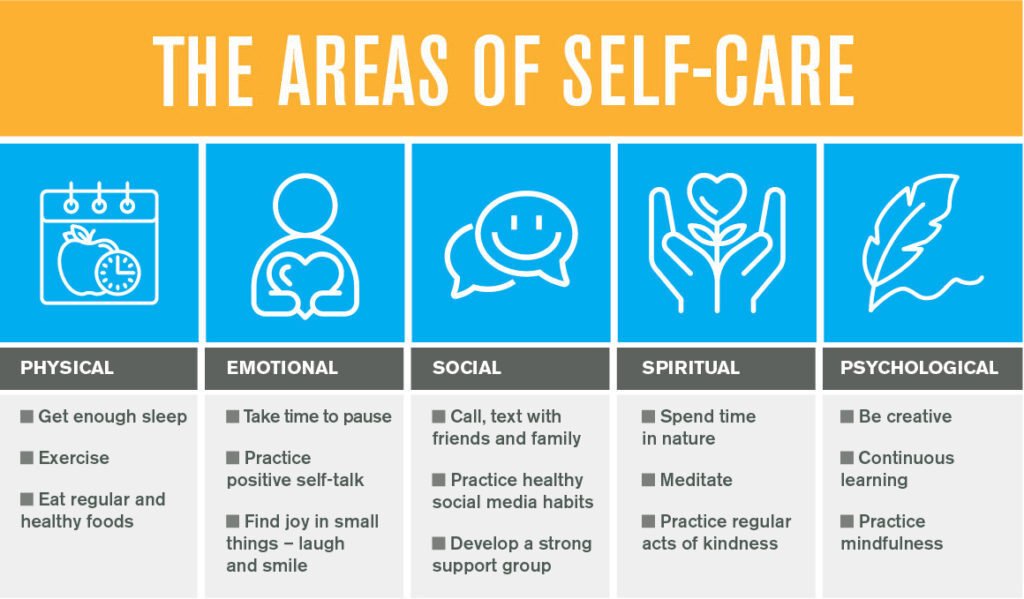
Following are seven aspects of self-care to consider:
1. Mental Self-Care
Mental/intellectual self-care is about cultivating a healthy mindset through mindfulness and curiosity. Mental self-care is important for developing a healthy mindset, growing your skills, reducing stress, and enhancing your knowledge and creativity.
Mental self-care ideas:
Prayer and meditation
Writing in a journal
Engaging your brain in a new way
Learning something new
Writing a brain dump list
Taking an intentional break away from technology/internet
2. Emotional Self-Care
Emotional self-care involves taking care of matters of the heart with healthy coping strategies and self-compassion. Tapping into emotional self-care helps you understand yourself more, deal with challenges and setbacks, and develop healthy emotional responses.
Emotional self-care ideas:
Watching a deep movie or meaningful book
Listening to your favorite songs
Writing down positive memories and experiences
Asking for help when you need it
Setting boundaries to protect your time and energy
3. Physical Self-Care
Physical self-care involves taking care of your body with exercise, nutrition, good hygiene, and proper sleep. When you practice activities for your physical well-being, you can increase your energy levels and boost your self-esteem.
Physical self-care ideas:
Eating meals at regular times (breakfast, lunch, and dinner)
Drinking more water
Taking vitamins daily
Getting 7-8 hours of sleep
Trying a new workout routine
4. Environmental Self-Care
Environmental self-care involves taking care of the spaces and places around you. The more you take care of your immediate environment, the more it will help you thrive and feel a sense of belonging where you are.
Environmental self-care ideas:
Arranging your workspace to be more comfortable
Exploring somewhere new
Decluttering your living space
Going outside for a walk
Appealing to your five senses
5. Spiritual Self-Care
Spiritual self-care involves caring for your soul through activities or practices that give your life a sense of purpose, direction, or meaning. Dedicating time to spiritual self-care can help you feel more grounded and connected to the world around you.
Spiritual self-care ideas:
Spending time in nature
Reading a spiritual book
Identifying your values and what’s meaningful to you
Volunteering or contributing to a cause you believe in
Connecting with God
Finding a spiritual guide
6. Recreational Self-Care
Recreational self-care involves caring for your inner person with hobbies, fun activities, and new experiences. Recreation is important because it lets you get away from the pressure of your to-do list and simply enjoy the pleasures that life has to offer.
Recreational self-care ideas:
Taking time for hobbies and creative activities
Going on an adventure by yourself or with others
Taking time to do absolutely nothing
Playing games
Switching up your regular daily routine
7. Social Self-Care
Even though self-care is about you, it’s important to connect with other people regularly. Social self-care means cultivating healthy relationships and connecting with people who get you and accept you. Seeking out positive social connections helps us create a sense of belonging and acceptance.
Social self-care examples:
Spending time with people whose company you enjoy
Calling or seeing relatives
Writing a letter to a friend
Talking to a support group
Finding a community or cause to contribute to
Joining a faith community